About Zion Lodge No. 1
Michigan's First Masonic Lodge, serving our community since 1764
Our History
Over 250 years of tradition, fellowship, and service in Detroit
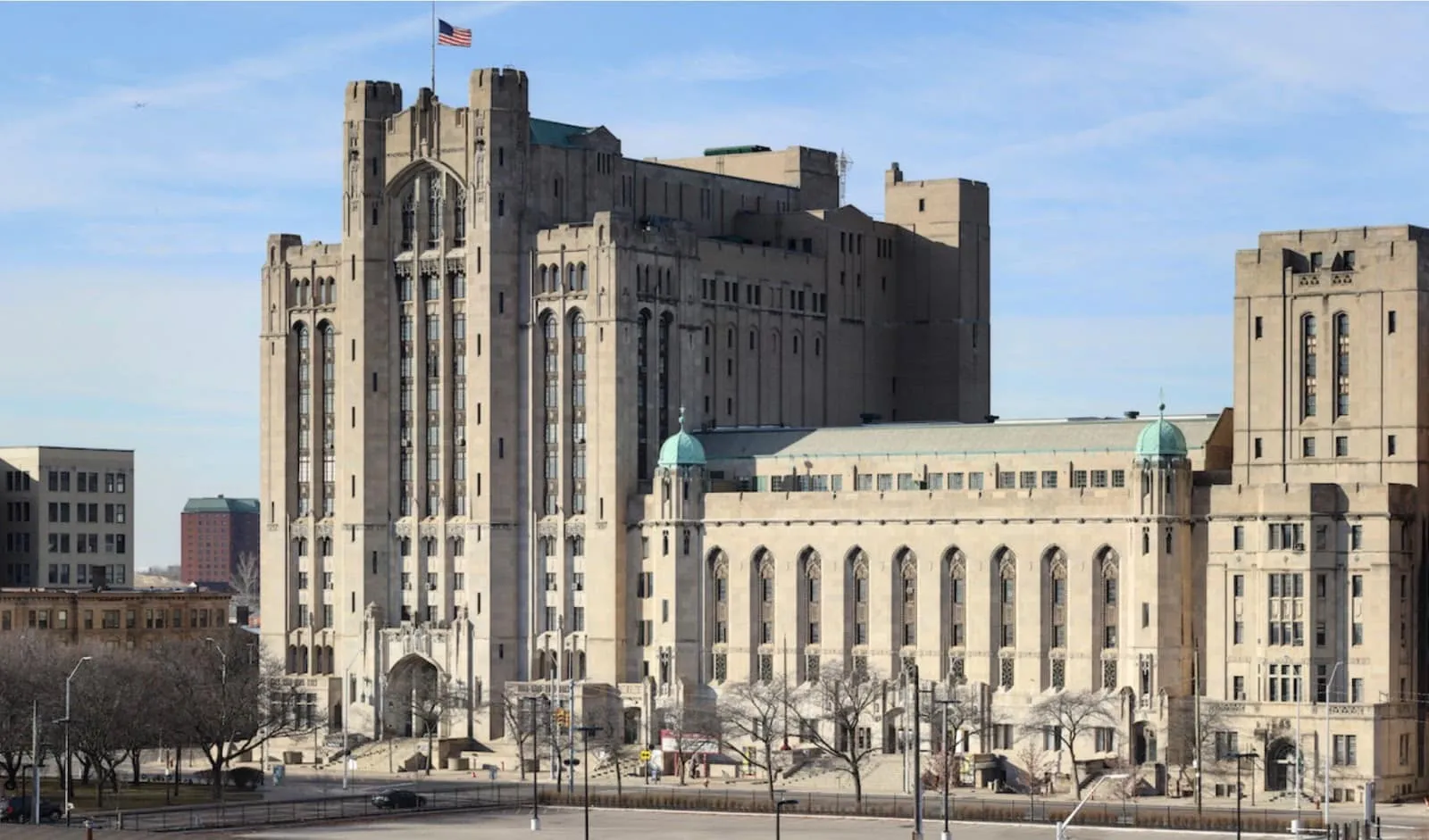
Chartered on April 27th, 1764, Zion Lodge No. 1 holds the distinction of being Michigan's first Masonic Lodge. Our lodge was established during the British occupation of Detroit, and we have witnessed and participated in every major chapter of Michigan's history.
From helping establish the University of Michigan in 1817 to supporting our community through times of war and peace, Zion Lodge has been a constant presence in Detroit for over two and a half centuries.
The Early Years
The history of Zion Lodge is interwoven with the fabric of the history of Detroit and Michigan. The second oldest extant organization in the city of Detroit, the roots of Zion Lodge can be traced to the middle part of the 18th century and the early development of the North American continent. At that time, Britain, France, and Spain were each carving out their spheres of influence and vying for dominance. After a period of extended warfare, the French possessions encompassing what would become Detroit fell to the British in November 1760. Major Robert Rogers (member of St. John's Lodge in Portsmouth New Hampshire) of the 60th or Royal American Regiment accepted the surrender of Francois-Marie Picoté de Belestre (a member of Tendere Fraternite Lodge).
Our program from our 150th anniversary from 1914 describes the environment at that time:
"Michigan, at this time, for military purposes, was a part of Canada, and Detroit was a British military post, "far beyond the frontier." All of what is now known as Western New York, Northern Ohio and Upper Canada, was then a wilderness. Along the Detroit River, on both sides, there were, according to the best authorities, some three or four hundred French families, representing two thousand to twenty-five hundred souls; but Detroit proper contained about "five hundred souls," living in "seventy to eighty log houses," all closely huddled together and surrounded by a stockade, "about twenty feet high and twelve hundred yards in circumference." The official census of 1768 (four years later,) shows that the Post had "five hundred and fourteen cultivated acres," "six hundred horned cattle and five hundred and sixty-seven hogs.'
The Ottawa, Potawatomie and Wyandotte Indians occupied the banks of the Detroit River, above and below, and they were united, for offense and defense, under the dangerous leadership of the noted and powerful chieftain Pontiac. The white people were mainly French, with a few Scotch and English from Canada. Nearly all subsisted by the fur trade.
It was in such soil and amid such environments that the seeds of Masonry were first planted would be planted."
Several officers of the 60th Regiment were Masons, and with travel back east to attend Lodge not being an option petitioned the Provincial Grand Lodge of New York to form a Lodge. Provincial Grand Master George Harison granted a Warrant dated April 27th, 1764 to open a Lodge of Master Masons in Detroit. The Warrant granted the power to "make Masons as also to do and execute all things as lawful in masonry." Lieutenant John Christie, Sampson Fleming, and Josias Harper were listed respectively as Worshipful Master, Senior Warden, and Junior Warden.
Growth and Change
On September 7th, 1794, Zion Lodge obtained a new warrant under the Provincial Grand Lodge of Canada and was listed as Number 10 in the registry. The first meeting took place on December 19th, 1794 in the home of Brother James Donaldson. Two years later, the city of Detroit became a part of the United States. The international border between the US and Canada at that time was more of an informal situation with travel back and forth frequent and usually unencumbered. In 1801, Zion helped to establish Adoniram Lodge (known today as Thistle Lodge No. 34) in Amherstburg. Zion would become a part of the Grand Lodge of New York again in 1806.
The winds of war returned in 1812, with Detroit occupied by the British from August 1812 to September 1813. The Lodge minutes note that the decision was made not to meet until conditions allowed. Following the return of American control and period of dormancy, Zion received a new charter from the Grand Lodge of New York as Zion Lodge No. 62 (renumbered as No. 3 three years later).
In 1817, Zion Lodge raised over $5,000 in today's dollars from its membership to help establish the University of Michigan.
The Grand Lodge of Michigan
In 1826, with the effort toward Michigan statehood underway and a desire for Masonic autonomy at the forefront, the process of forming the Grand Lodge of Michigan began. Delegates met at the Council House in Detroit on June 24th to formalize arrangements. This was completed on July 31st with the completion of the Bylaws and Constitution and election of Grand Officers. The following year, the Grand Lodge was incorporated by the Territorial Legislature and the constituent Lodges were numbered in accordance of date of charter (Zion No. 1, Detroit No. 2, Oakland No. 3, Menominee No. 4, Monroe No. 5).
A period of anti-Masonic feeling spread throughout the northern United States in 1829 following the events of the "Morgan Affair" in New York. Many emigrants to Michigan were from upstate New York and brought their anti-Masonic prejudices with them. To protect the safety of its members, Grand Master Lewis Cass ordered all Lodges in Michigan to stop meeting in that year.
With the resultant issues subsided, the Grand Lodge of New York reissued a charter to Zion in 1844, listed as No. 99. On June 5th, 1845, a new Grand Lodge of Michigan was established. The charter that Zion Lodge currently operates under dates from then.
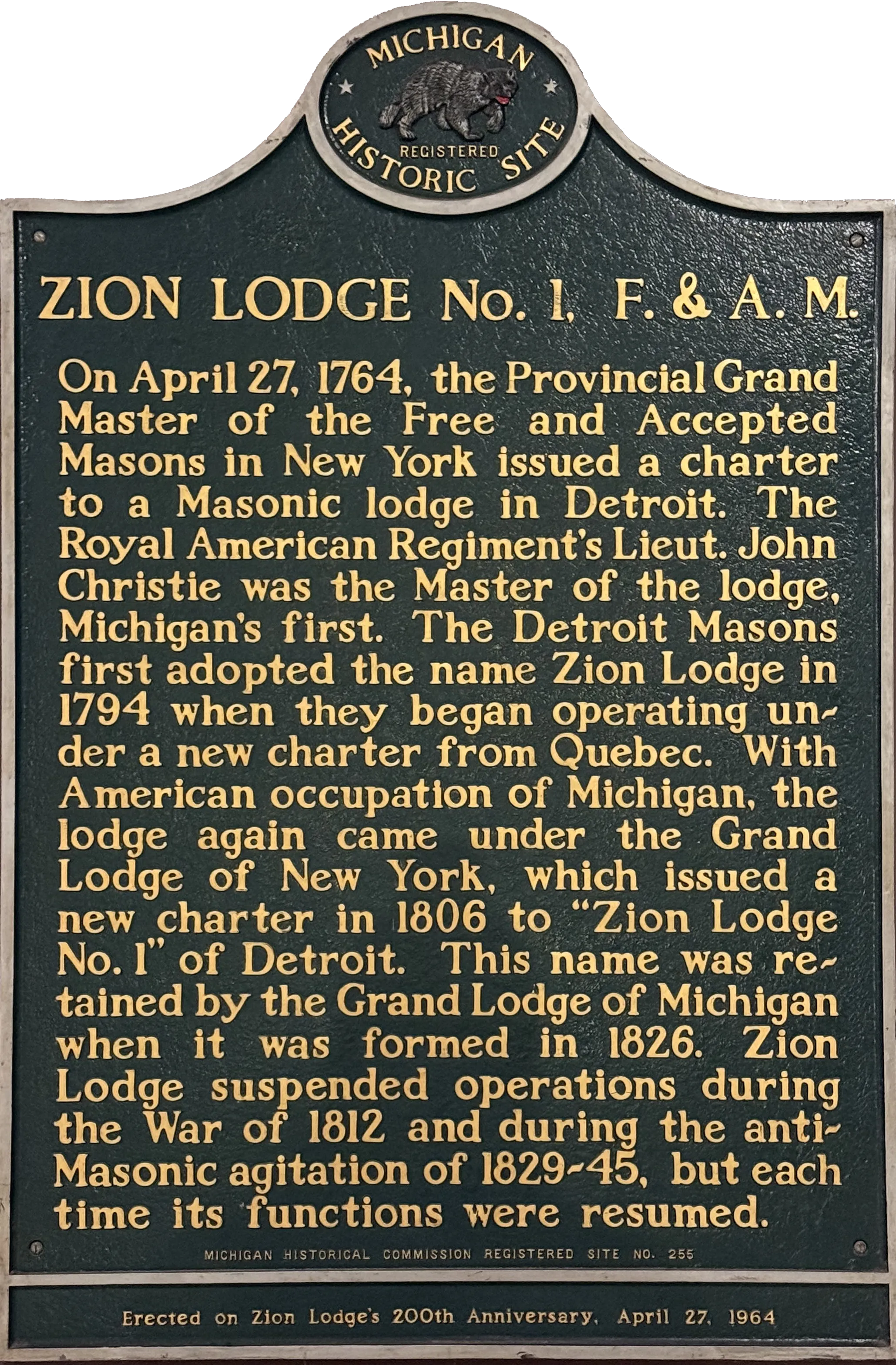
A Legacy Commemorated
More than two and a half centuries of continuous presence in Detroit are not merely preserved in archives and minute books — they are etched in stone and bronze. The plaque below stands as a permanent public acknowledgment of Zion Lodge's founding and its enduring place in the history of Michigan and American Freemasonry.
From a British military post on the frontier of a young continent to one of America's great industrial cities, Zion Lodge has endured every upheaval — wars, epidemics, economic booms and busts — and emerged still practicing the same ancient rites, still admitting men of good character, still bound by the same obligations. That continuity is itself a kind of monument.
Current Officers
Leadership serving for the current Masonic year
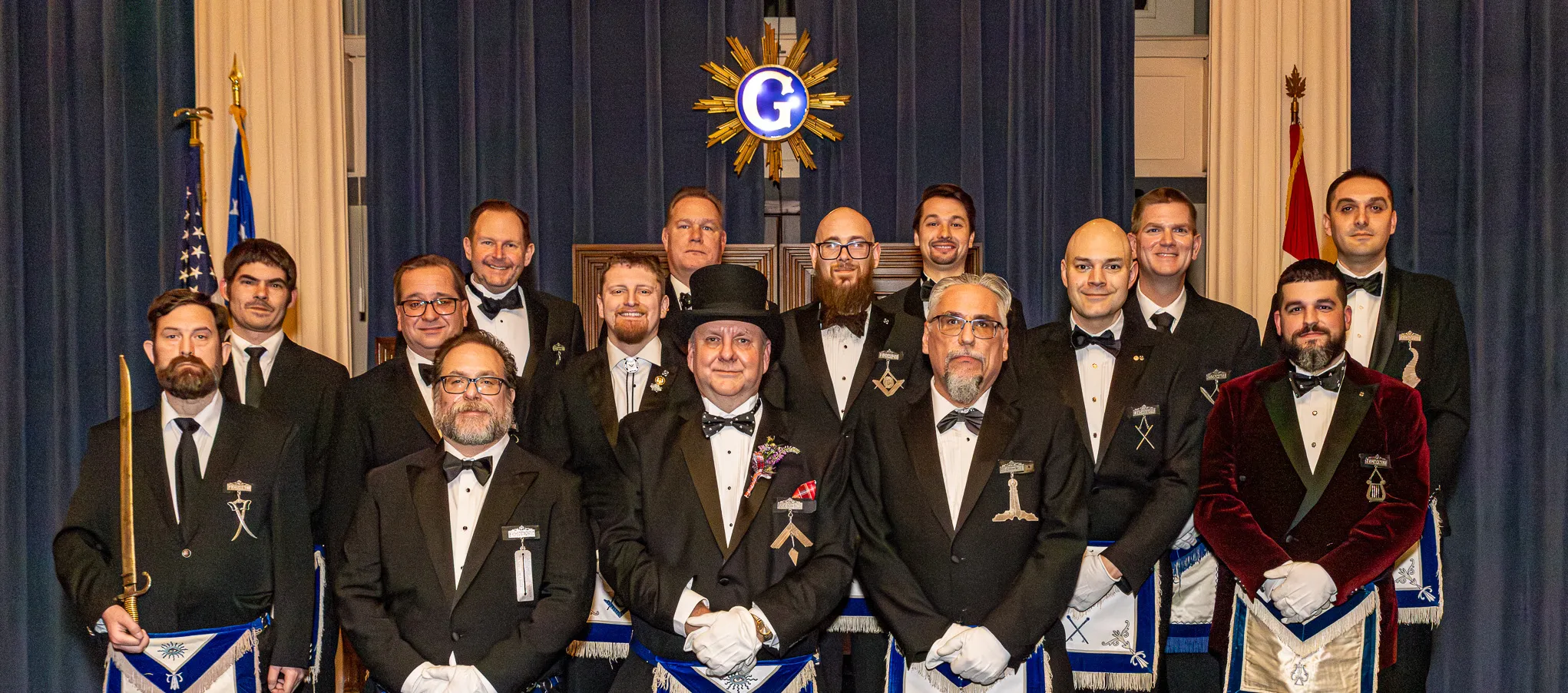
Worshipful Master
Scott B. Kuzma
Senior Warden
Michael D. Domzalski
Junior Warden
Jamison Jaramillo
Treasurer
Thomas M. Melnychenko
Secretary
Roy E. Andersen
Chaplin
Josh A. Daniels
Senior Deacon
Josh F. DeBolt
Junior Deacon
Christopher L. Conrad
Steward
David M. Aller
Steward
Zac D. Green
Steward
Daniel G. Jernigan
Steward
Julian Vataj
Marshal
Brian D. Jankowski
Musician
Brandon P.C. Langford
Tiler
Robert A. Moore
Lodge Education
Robert A. Moore
Ready to Learn More?
If you're a man of good character seeking fellowship, personal growth, and the opportunity to serve your community, we invite you to learn more about becoming a Mason.