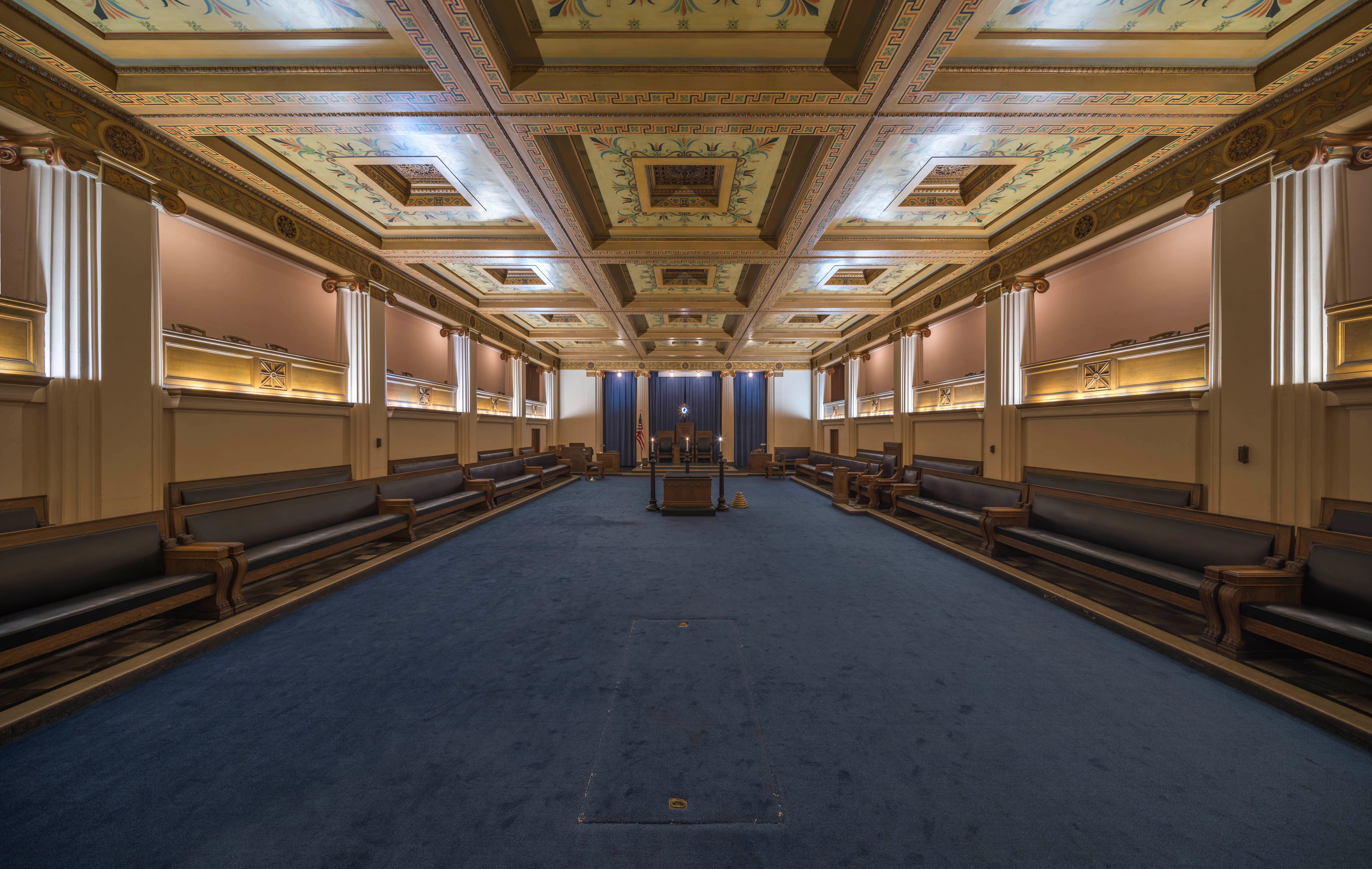
The Lodge Room
Step inside Michigan's oldest Masonic Lodge — a space where architecture, symbolism, and 260 years of tradition converge.
The Coffered Ceiling
The ceiling is one of the room's most arresting features. A deep grid of dark-stained wooden beams divides the overhead plane into a series of recessed coffers — a design inherited directly from classical Greek and Roman architecture, where such ceilings adorned temples and basilicas. Each coffer is painted with delicate botanical motifs: flowing stems, leaves, and blossoms rendered in teal and soft blue against a cream ground. The botanical imagery is not mere decoration; in Masonic tradition, the acacia plant in particular symbolizes immortality and the endurance of the soul. A continuous Greek-key (meander) border frames the entire ceiling, its interlocking right-angle pattern evoking the winding path of life and the infinite nature of eternity. The coffers are lit from within, bathing the room in warm, diffuse light that softens the solemnity of the space.
Coffered ceiling of Zion Lodge No. 1 with painted botanical panels
The Ionic Columns
Running along both the north and south walls is a colonnade of Ionic columns — readily identified by their distinctive scroll-shaped capitals (volutes). This order sits between the plain Doric and the elaborate Corinthian in the classical canon, representing learning, wisdom, and the middle path. In Freemasonry the three classical orders carry deep allegorical weight: the Doric represents strength, the Ionic wisdom, and the Corinthian beauty — precisely the three great supports of a Masonic Lodge. The columns here are rendered in white and gold, standing against the warm ochre of the walls. Between each column, recessed wall panels are punctuated by cross-pattée medallions — four-armed crosses of equal length, echoing the Christian heritage woven through the Craft's symbolism.
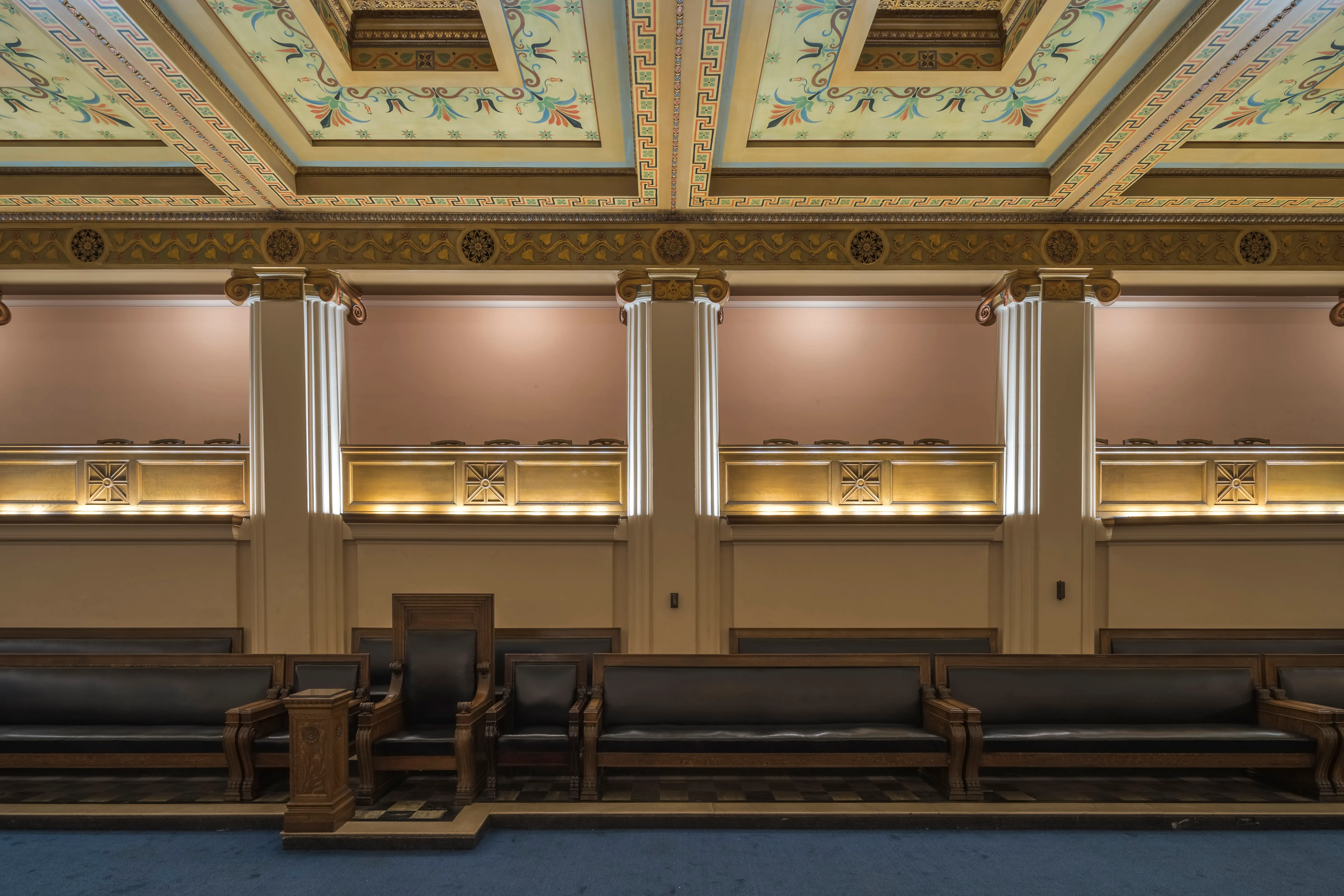
Ionic columns lining the walls of the lodge room
The Altar
At the geographic and symbolic center of the lodge room stands the Altar — a heavy wooden pedestal upon which the Volume of Sacred Law rests, open during every stated communication. The Altar is the most sacred piece of furniture in the lodge. Members circumambulate it during ritual, and all obligations (oaths of brotherhood) are taken upon it. Its central placement is intentional: everything in the lodge room radiates outward from the Altar, reminding each Brother that his obligations and the Sacred Law are the fixed point around which his Masonic life revolves. The floor around the altar bears the mosaic pavement — symbolic of the vicissitudes of life — and small inlaid markers that guide candidates through ritual movement.
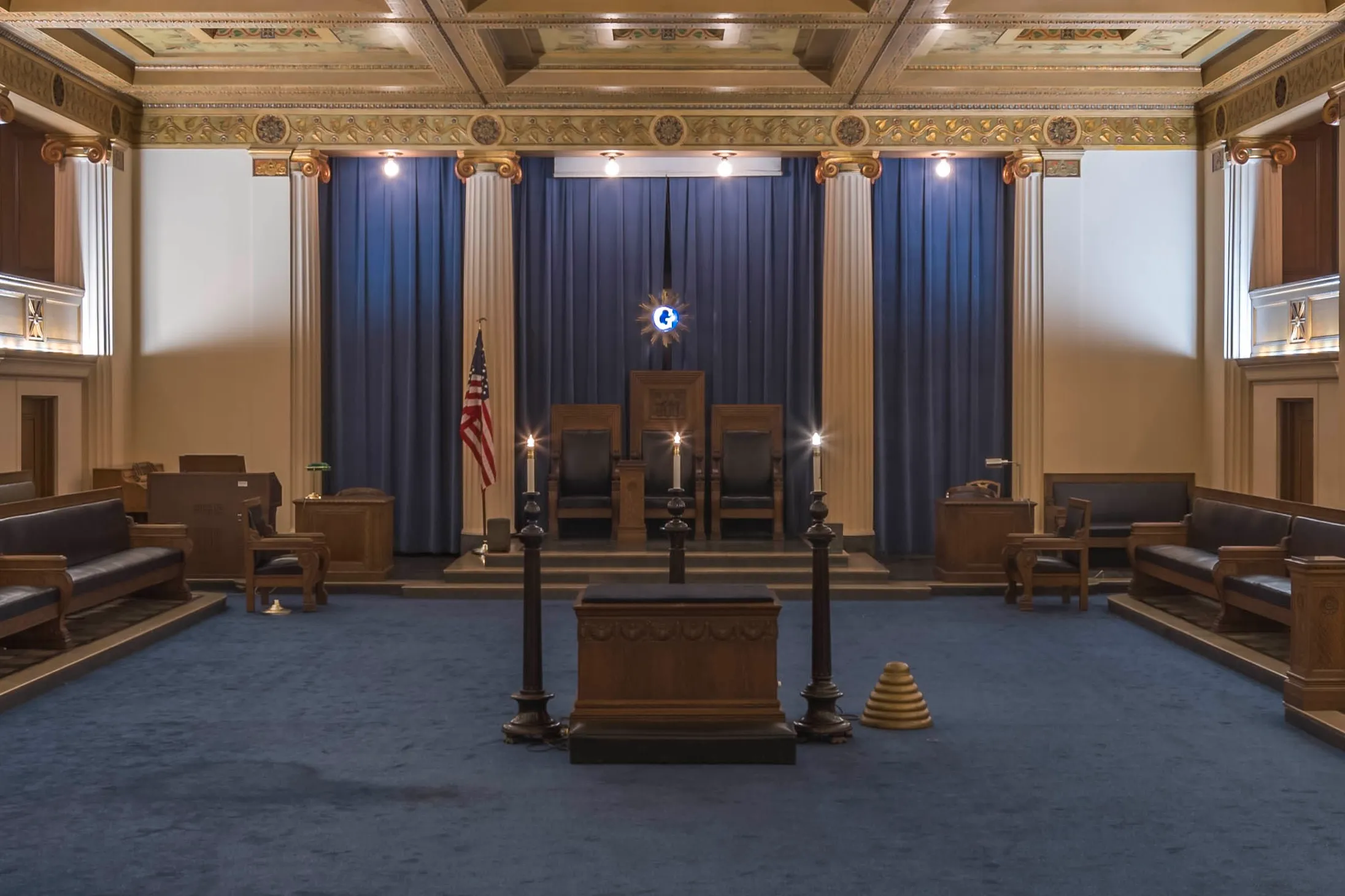
The central altar of Zion Lodge No. 1
The East — Station of the Worshipful Master
The East wall, framed by deep blue curtains, is the most architecturally prominent end of the room. This is where the Worshipful Master — the presiding officer of the lodge — sits in a raised, throne-like chair flanked by two tall candlesticks. In Masonic symbolism, the East is the direction from which light originates. Just as the sun rises in the East to illuminate the world, the Worshipful Master 'opens' the lodge and dispenses Masonic light (knowledge and wisdom) to the members. The letter 'G' — representing both Geometry and the Grand Architect of the Universe — is traditionally displayed at this focal point. Two freestanding columns guard the entrance to the East, an allusion to the two great pillars Boaz and Jachin that stood at the portico of King Solomon's Temple. The American flag stands at the left, a reminder of the lodge's civic duty and patriotism.
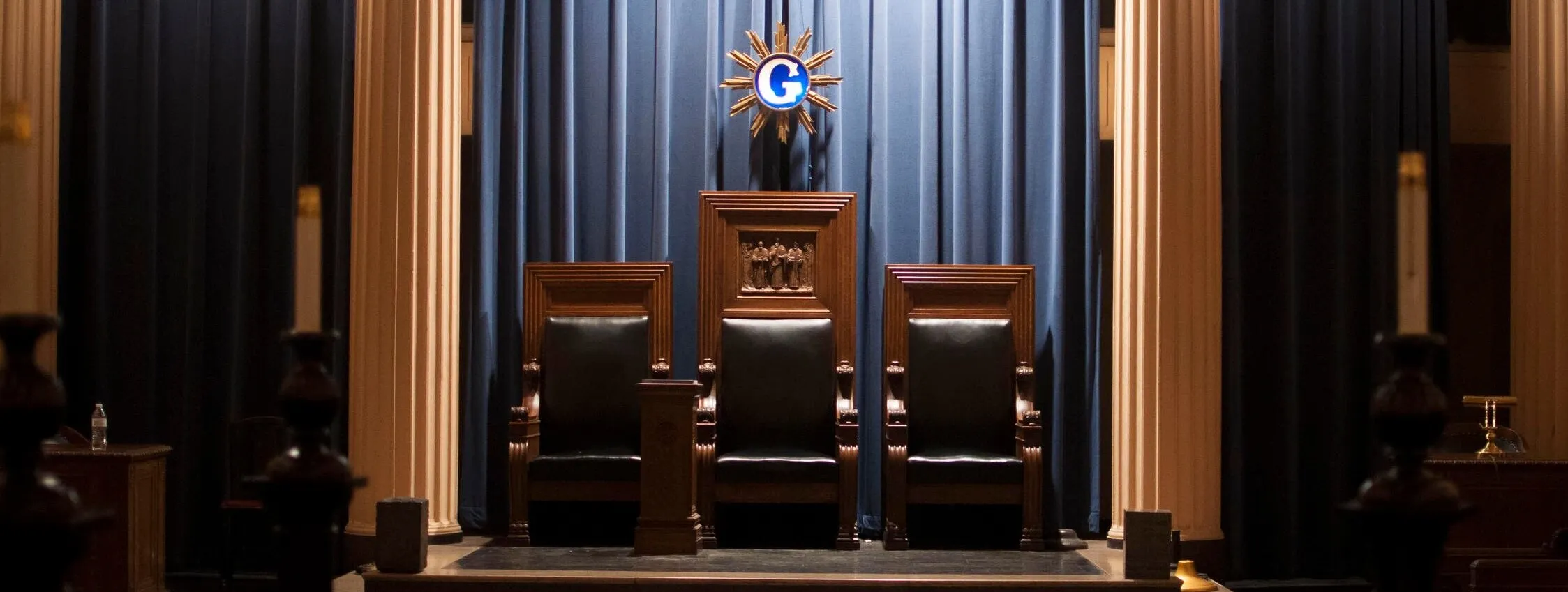
The East wall with the Worshipful Master's chair and blue curtains
The Seating & Orientation
Dark-stained wooden benches with black leather cushions line both the north and south sides of the room. Members sit facing inward toward the center aisle and the Altar, encouraging a sense of equality and mutual attention. Unlike a church where all eyes face one direction, the lodge room arrangement makes clear that Brothers face one another — reinforcing the principle of brotherly love and mutual regard. The layout also mirrors the cardinal directions: the Worshipful Master presides in the East; the Senior Warden, who oversees labor, sits in the West; and the Junior Warden, who calls the lodge to refreshment, sits in the South. This orientation is a living map of the lodge's symbolic geography.
Wooden pews and blue carpet of the lodge room interior
The Blue Carpet & Symbolic Floor
The rich royal-blue carpet that covers the floor is more than an aesthetic choice. Blue has been the color of symbolic Masonry — often called 'Blue Lodge' — for centuries. It represents universal friendship and benevolence, qualities every Mason is charged to cultivate. Historically the color was associated with the sky and the heavens, linking the lodge to ideals that transcend the material world. Embedded within the carpet near the Altar are markers corresponding to the lodge's tracing board — a symbolic diagram used in ritual instruction. These floor markings guide candidates step by step, making the very act of walking through the room an act of instruction.
Royal blue carpet of the lodge room
Ready to Enter the Lodge?
The room above is where every candidate for Freemasonry first encounters the light of the Craft. If you feel called to learn more about membership at Zion Lodge No. 1, we welcome your inquiry.